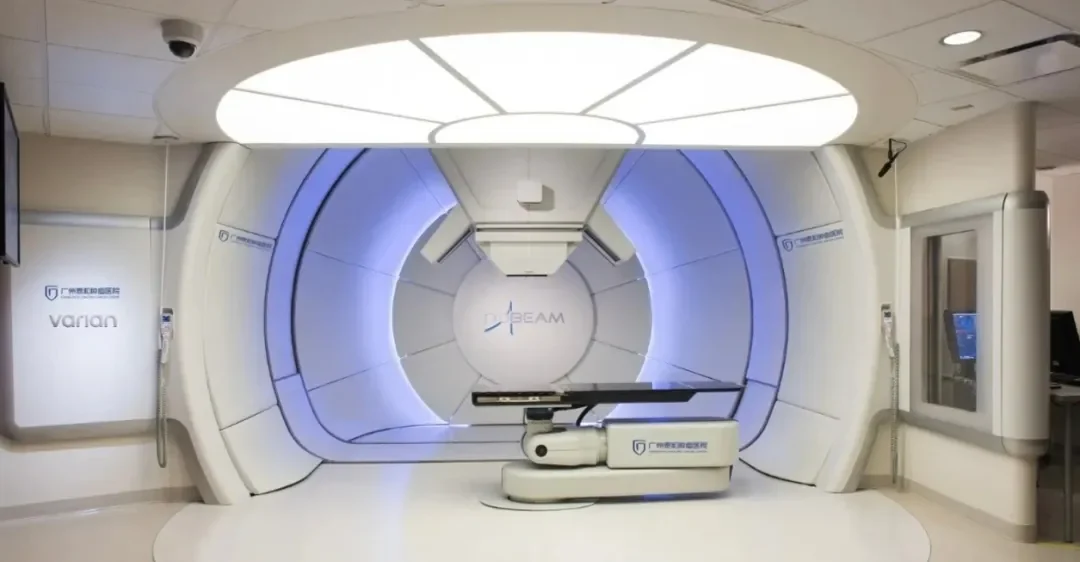
For patients with early breast cancer who undergo breast-conserving surgery, postoperative radiotherapy is an important part of comprehensive care. The goal is to reduce the risk of local recurrence while protecting nearby healthy tissues such as the heart and lungs, and preserving breast appearance and quality of life.
As radiotherapy techniques and clinical evidence continue to evolve, how to reduce the number of treatment sessions and the burden of travel to hospital without compromising quality is an ongoing direction of exploration. Recently, the Radiation Oncology Department at Guangzhou Concord Cancer Center launched a prospective phase II clinical study of ultra-hypofractionated proton therapy after breast-conserving surgery in early breast cancer, exploring a more streamlined treatment process and individualised dose design.
01 A Prospective Phase II Study: Shorter Courses and Standardised Treatment
The study, titled "A prospective, single-arm phase II study of ultra-hypofractionated proton therapy with whole-breast irradiation followed by sequential tumour-bed boost after breast-conserving surgery in early breast cancer," is led by Guangzhou Concord Cancer Center with participation from collaborating public tertiary hospitals. It examines the efficacy and side effects of ultra-hypofractionated proton therapy in patients after breast-conserving surgery.
Eligible patients are mainly those with invasive breast cancer who have undergone breast-conserving surgery with negative margins, pathological stage pT1–2N0–1mic and no distant metastasis, and who are assessed by the radiation oncology team as requiring whole-breast and tumour-bed radiotherapy. Other protocol-defined risk factors and inclusion criteria also apply. Whether a patient is suitable must be determined formally by the study team against the full criteria — it cannot be judged on the number of fractions, age or any single pathological finding alone.
Under the protocol, whole-breast irradiation is prescribed at 26 Gy in 5 fractions (5.2 Gy per fraction), with a sequential tumour-bed boost of 8.7 Gy in 3 fractions (2.9 Gy per fraction) as needed. Treatment is planned to be completed in about 5–8 working days. Compared with schedules requiring more visits, this approach is expected to reduce the number of trips to hospital and the burden of transport and accompanying care, making it easier to coordinate work and daily life.
The study plans to enrol 93 patients and will systematically collect acute and long-term adverse reactions, evaluating breast appearance and cosmetic outcome, locoregional control, progression-free survival, overall survival and quality of life. Follow-up is scheduled every 3 months for the first two years after radiotherapy and every 6 months thereafter. Through continuous follow-up, the team will further assess the tolerability of this proton therapy regimen, changes in breast appearance and disease control.
02 What Is Ultra-Hypofractionated Radiotherapy?
Radiotherapy is not delivered in a single session; the total dose is divided into a number of fractions — a "fractionation schedule." In postoperative breast radiotherapy, conventional fractionation is typically 50 Gy in 25 fractions over about 5 weeks, while moderate hypofractionation is 40–42.5 Gy in 15–16 fractions over about 3–4 weeks and has become a standard choice for many patients. Ultra-hypofractionation further compresses treatment to 26 Gy in 5 fractions over about one week. Whether ultra-hypofractionation is appropriate still depends on the patient's specific condition, treatment goals and the relevant clinical evidence.
Fewer fractions do not mean that pre-treatment preparation or quality requirements can be omitted. Positioning and immobilisation, CT scanning, delineation of the target volume and organs at risk, plan optimisation and verification are still required before treatment, and image guidance and position checks must follow protocol during treatment. Proton therapy is sensitive to changes in anatomy and tissue density, so plan evaluation, patient-specific plan verification and quality control during treatment are especially important.
03 Efficacy and Safety: Looking at the Target Volume and Long-Term Quality of Life
Breast radiotherapy must not only deliver an adequate dose to the target volume, but also minimise dose to nearby healthy tissues such as the heart and lungs, while paying attention to breast appearance and quality of life after treatment. The FAST-Forward randomised phase III trial provided evidence for shorter-course photon radiotherapy in some patients with early breast cancer; this study, however, uses ultra-hypofractionated proton therapy with an added sequential tumour-bed boost, so its safety, cosmetic outcome and long-term disease control still need to be evaluated through standardised treatment and continued follow-up.
Breast radiotherapy has clear therapeutic value, but it may cause skin redness, dryness, pigmentation, breast swelling or pain and fatigue; some patients may also develop late tissue fibrosis or changes in breast appearance. Proton therapy improves the conformity of the target dose while reducing radiation to surrounding healthy tissue, though the actual benefit varies between individuals. Accurate assessment before treatment, quality control during treatment and regular follow-up afterwards are therefore equally important.
This study will focus on acute and long-term treatment-related adverse reactions, while also assessing breast cosmetic outcome, locoregional control, survival outcomes and quality of life. By systematically collecting clinical data and conducting long-term follow-up, the team hopes to further understand the safety and feasibility of this regimen and provide evidence for optimising radiotherapy after breast-conserving surgery in early breast cancer.
04 A Case: Five-Fraction Ultra-Hypofractionated Proton Therapy
Patient profile. A 50-year-old woman underwent lumpectomy of the left breast and sentinel lymph node biopsy. Postoperative pathology showed invasive breast cancer, with a maximum tumour diameter of about 1.1 cm, histological grade III, negative margins, no lymphovascular invasion and no sentinel node metastasis — pathological stage pT1cN0M0, stage IA. Immunohistochemistry showed oestrogen receptor (ER) positive at about 30%, progesterone receptor (PR) positive at about 2%, HER2 3+ and Ki-67 at about 25%, indicating HER2-positive disease with low hormone-receptor expression. Following comprehensive postoperative assessment, she received left whole-breast proton radiotherapy with a sequential boost to the tumour bed.
Overall plan evaluation showed that the plan covered the breast and tumour-bed target volume while controlling dose to the heart and both lungs: mean heart dose (Dmean) 2.35 cGy and V300cGy 6.65%, reflecting the balance between target coverage and normal-tissue protection in plan design. During treatment the patient developed mild skin redness (grade I radiation dermatitis) and breast oedema.
Conclusion: More Convenient Treatment, More Rigorous Assessment
From conventional fractionation to hypofractionation and ultra-hypofractionation, the evolution of breast radiotherapy has always sought a better balance among treatment quality, normal-tissue protection and patient convenience. Together with its collaborating teams, Guangzhou Concord Cancer Center will evaluate the efficacy and side effects of ultra-hypofractionated proton therapy after breast-conserving surgery in early breast cancer through standardised treatment processes, strict plan quality control and continued follow-up.
For patients, the convenience of fewer sessions is certainly worth noting, but what matters more is choosing a regimen suited to their own pathology, surgical situation, systemic treatment plan and individual dosimetric assessment — and adhering to regular follow-up.
Written by Zhu Xuan, attending physician, Department of Radiation Oncology, Guangzhou Concord Cancer Center. Medically reviewed by Yuan Taize, Director of the Department of Radiation Oncology and Proton Center.